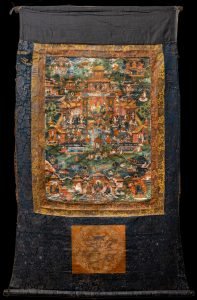
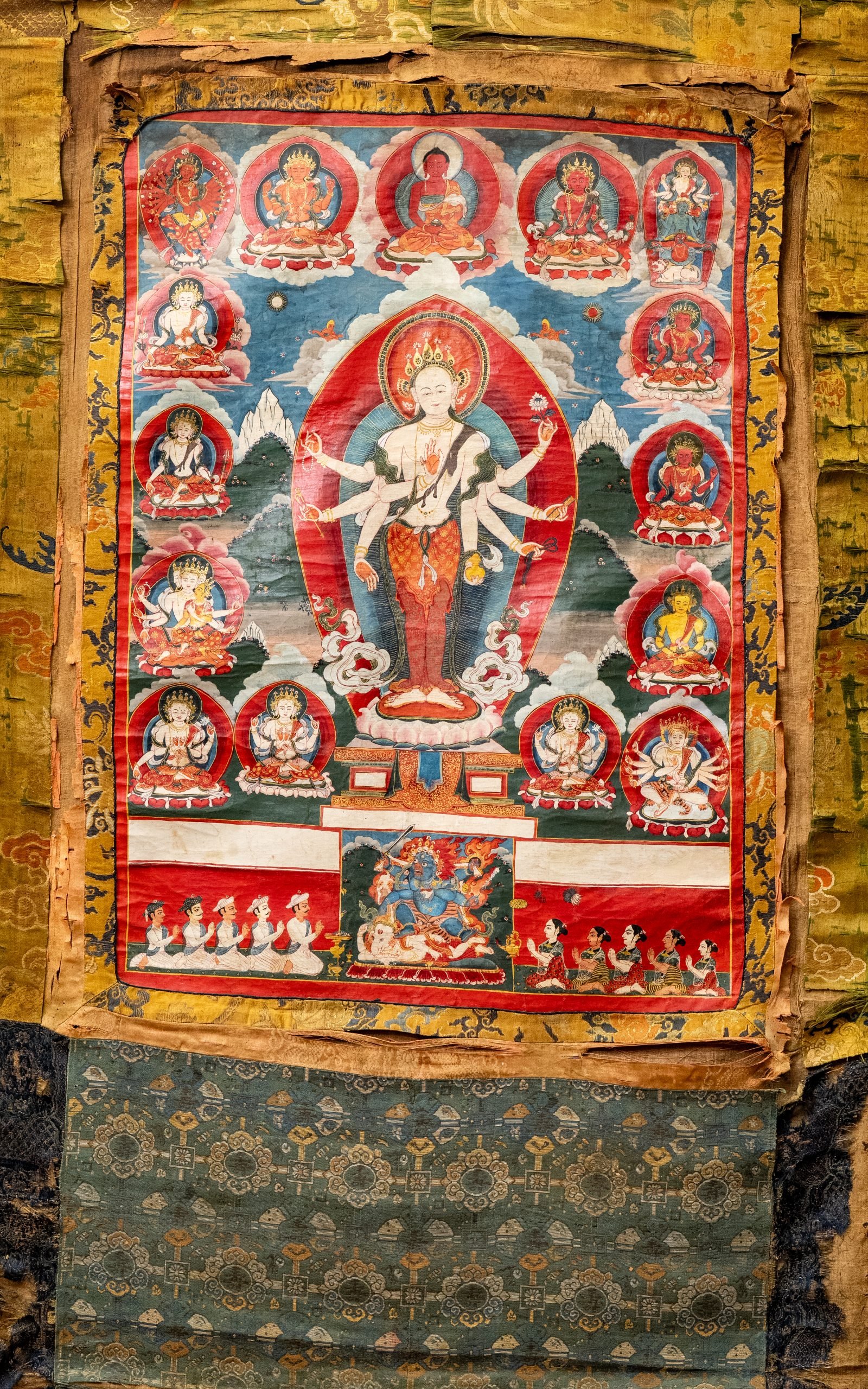
Dimensions: (image+silk frame) 129x82cm , (image) 76×55 cm
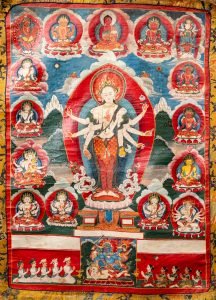
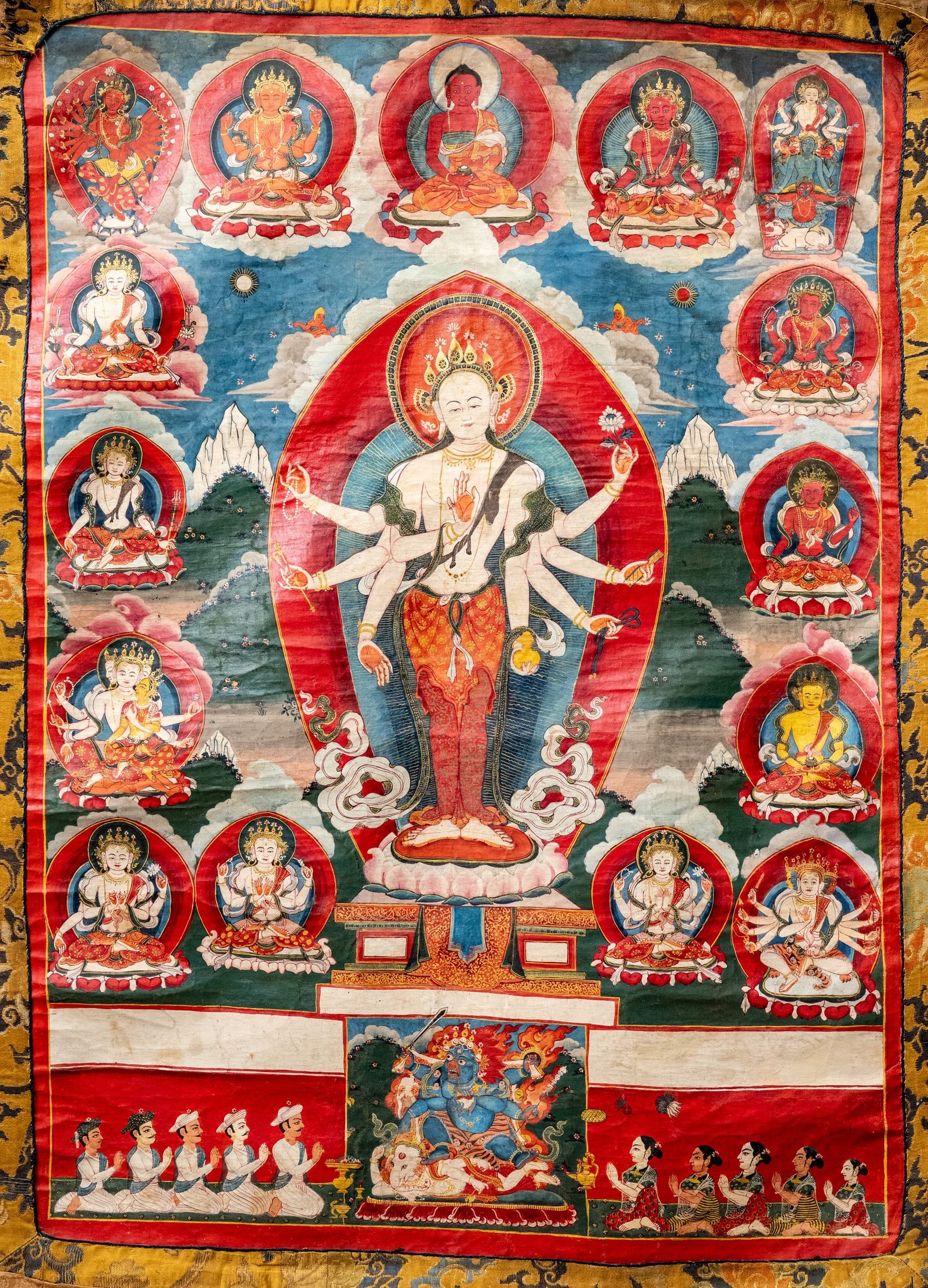
At the centre of this richly detailed Nepalese thangka stands Amoghapāśa, the white, eight-armed bodhisattva of compassion, whose name means “The Unfailing Lasso.” Particularly revered in Newar Buddhism, he embodies the power of compassion to guide sentient beings away from suffering and towards liberation. In his right hands hold prayer beads (mālā) and hand plough (lāṅgala), in his left hands he holds lotus flower (padma), palm-leaf manuscript (pustaka) and a lasso (pustaka). Each expresses a different aspect of his salvific activity: wisdom, generosity, fearlessness and the skilful means through which beings are guided towards awakening. His remaining two right hands form the varada mudrā, the gesture of giving, and the abhaya mudrā, the gesture of fearlessness. Surrounding the central deity is an extraordinary assembly of divine manifestations, including Amitābha Buddha, several forms of Avalokiteśvara, and figures from the Hindu pantheon. Rare forms such as the dancing Padmanarteśvara and the composite deity of Hari Hari Hari Vāhana – Avalokiteśvara, his mount, a white lion, Vishnu and his own mount, the Garuda – reveal the richness of Nepal’s Buddhist iconographic traditions. At the bottom, the wrathful protector Mahākāla tramples an elephant, symbolising the subjugation of ignorance and the uncontrolled nature of mind, while rows of lay devotees present their offerings. More than a devotional image, this thangka is a visual expression of Nepalese Buddhist thought, bringing together textual traditions, complex iconography and the many dimensions of compassion, wisdom and liberation.